
Salina Previous Residents Sources
One address needs different records for different eras. Onondaga County land records begin in 1794, while the assessment roll is a current, annual owner-centered source. OCPL provides dated city directories, telephone books, newspapers, obituary leads, cemetery databases, and local-history material. The County Clerk Archives hold local census material for 1850 through 1925, and the released federal census currently reaches 1950. A source can identify a transfer, a printed occupant, or a household snapshot, but no one source proves every past resident of a Salina address.
| Source | Years it covers | Where held | What it shows |
|---|---|---|---|
| Onondaga land records | 1794 to present record start; scope varies | County Clerk, Cott, and archives | Transfers, mortgages, releases, and legal descriptions |
| Deed and mortgage numerical indices | 1799 to 1986 digitization scope | County Clerk records project | Numbered index access, not a promise of every image |
| Assessment rolls | Current town data, annual final roll | Salina assessor, RPTS, and Go2Gov | Owner, situs, owner address, class, value, and parcel |
| Syracuse city directories | 1844 to present, with gaps | OCPL Central LHG and FamilySearch | Dated name and address snapshots |
| Telephone directories | 1894 to present | OCPL Central LHG | Address continuity, with unlisted and gap limits |
| Census records | County 1850 to 1925; federal through 1950 | Clerk Archives and federal channels | Household, age, relationship, and geography snapshots |
| Obituary index | 1860 to 1996, incomplete | OCPL Central LHG | Death and newspaper leads |
Building permits are a possible construction or alteration source, but no official public Salina permit index or coverage years were located. Use the Town Planning or Code request route for an address and date range if retained records matter. The County Clerk Archives and the library are the fallback channels when a portal does not expose the earlier material.
Salina Property Records Start
Freeze the present parcel before searching names. The Onondaga County RPTS and Go2Gov property search offers Tax Map Number, Owner Name, Property Address, and Mailing Address modes. Retain the tax-map number, physical property location, current owner, current owner's address, tax description, class, exemptions, school district, parcel size or grid information, and roll date. The owner address can differ from the physical location. That difference is a locate clue, not proof that the owner or a household lived at the property.
When a street form fails, the parcel and legal description keep the work anchored. A property can have a rural description before numbering, a later lot after platting, or a postal city label that differs from its town jurisdiction. Salina addresses can carry Liverpool, Mattydale, or Syracuse labels. Store municipality, situs, postal city and ZIP, legal description, and record date separately. Do not make a missing or changed street form into a claim of a documented town-wide renumbering because no verified Salina renumbering year was located.
Note: A current assessment record is dated ownership evidence, so preserve the roll year before comparing it with an older deed or directory.
Salina Deed Record Chain
The backward ownership trail runs through the County Clerk's Cott eSearch land-record index. Sign in as a guest to search the index without charge. Document images and printing can require an account or subscription. Search the current assessment owner as a grantee, identify the latest deed, and copy its seller, recording date, legal description, book and page or document reference, subdivision or lot information, and consideration when shown. Then search that seller as a grantee to locate the earlier purchase. Repeat only while the legal description and parcel trail remain coherent.
- Record the current parcel, owner, legal description, and roll date from Go2Gov or the assessor.
- Search the current owner as grantee in Cott and identify the latest deed for the parcel.
- Copy the grantor, recording reference, date, and legal description from that indexed transaction or available image.
- Search the seller as the earlier grantee, then compare the legal description before extending the chain.
- Move index-only or unavailable-image entries to the Clerk counter or archives and retain every document reference.
- Grantor and grantee
- The grantor transfers an interest; the grantee receives it in the recorded instrument.
- Chain of title
- A documented sequence of transfers for the same property, checked through legal descriptions and recording references.
- Legal description
- The lot, block, tract, subdivision, or other land wording that can identify a property when a street address changes.
- Plat
- A recorded subdivision or tract map used to connect lots, blocks, and later street addresses.
Cott's guest index is the starting screen for the Salina previous residents ownership trail.
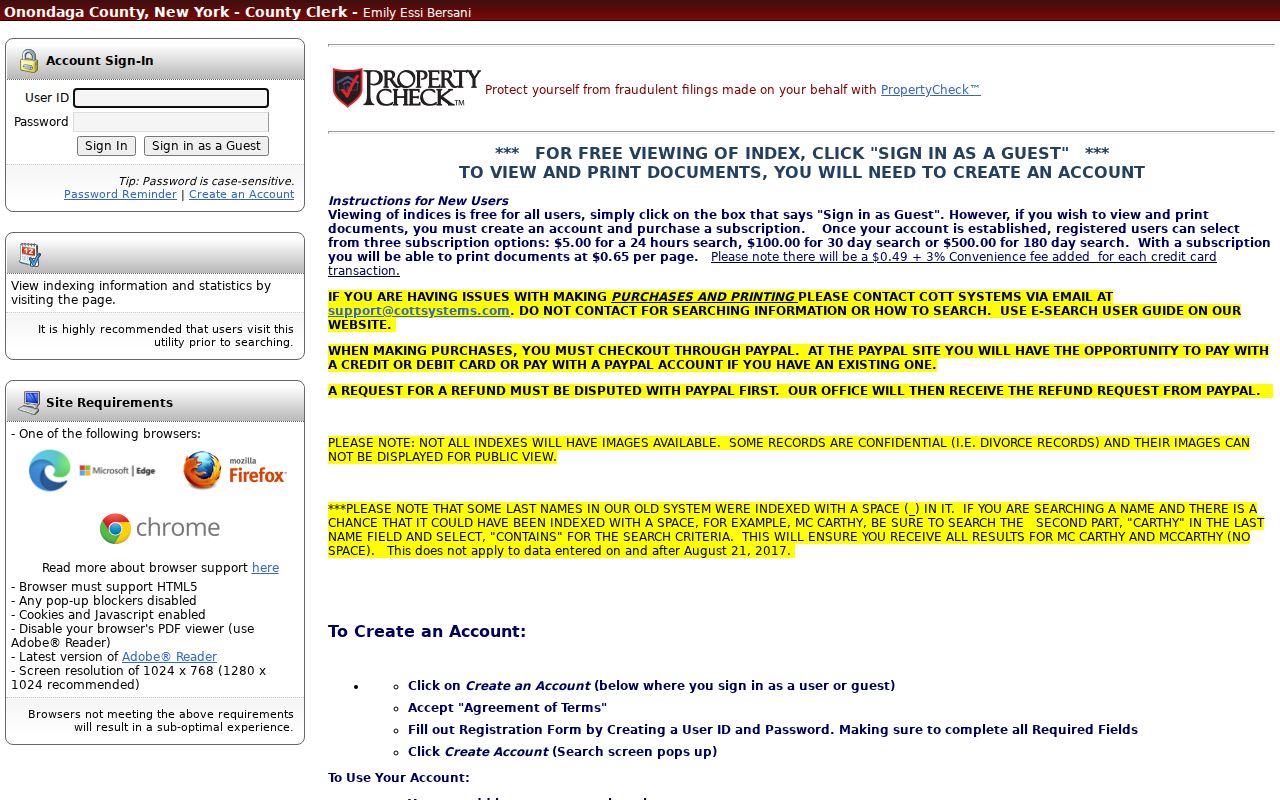
The image shows why an index entry, an available image, and a Clerk counter request should be treated as separate access states.
Salina Digitized Land Records
Onondaga's published digitization scope is useful, but it is not an online-image cutoff. The county capital plan describes a Records Digitization project completed by 2025 for paper mortgages from 1794 through 1950 and deed and mortgage numerical indices from 1799 through 1986. The same research does not state a single, complete searchable-image endpoint for deeds by document type. Mark each Cott result as index-only or image-available instead of assuming that a digitized numerical index supplies every deed image.
The County Clerk's 2024 annual report adds context: 61.67% of recorded documents were electronic and 80.97% of court records were electronically filed, while historical back-scanning continued. Those figures describe recording and filing activity, not the age of a particular Salina image. For handwritten, older, or unavailable records, use the Clerk Archives at 401 Montgomery Street, Room 200. The real-property line is 315-435-8250 and the archival line is 315-435-2237.
Salina Address Record Gaps
Address searching can break at the very point a property changes form. Switch from a failed street search to the tax-map number, lot, block, subdivision, former street spelling, grantor or grantee name, and legal description. County subdivision and tract maps reach back to 1799. The earliest land records can be handwritten, so older links may require Clerk counter, photostat, or microfilm work even if the name appears in an online index.
A nearby Syracuse 1892 Sanborn map volume is a useful fire-insurance and building-context source for Syracuse. It is not evidence that a particular Salina address was mapped. No Salina-specific Sanborn run was confirmed in the reviewed material. For a construction date, triangulate a plat, assessment class or parcel, directory first appearance, newspaper notice, and a Planning request if a permit record survives.
Salina OCPL House Records
OCPL does not publish a single titled Salina house-history guide or a verified fee-based house-history service. Its additional-sources collection page is the working route instead. It brings together city directories, telephone books, newspapers, tax rolls, maps and atlases, church records, WPA files, cemetery records, county histories, and microfilm. Use it to layer a household question over the deed chain without treating any one book as a complete occupant roster.
OCPL Central Local History/Genealogy is at 447 South Salina Street, third floor, Syracuse. Its in-room materials do not circulate. The room can answer brief specific questions by phone or email and uses call slips for special-storage material. A city directory result may be paired with a telephone book, an obituary lead, or a cemetery citation before the researcher turns back to probate and transfers. The city-directory collections themselves are described in the Salina directory book.
OCPL's additional-sources page supplies the local research menu for a Salina address history.
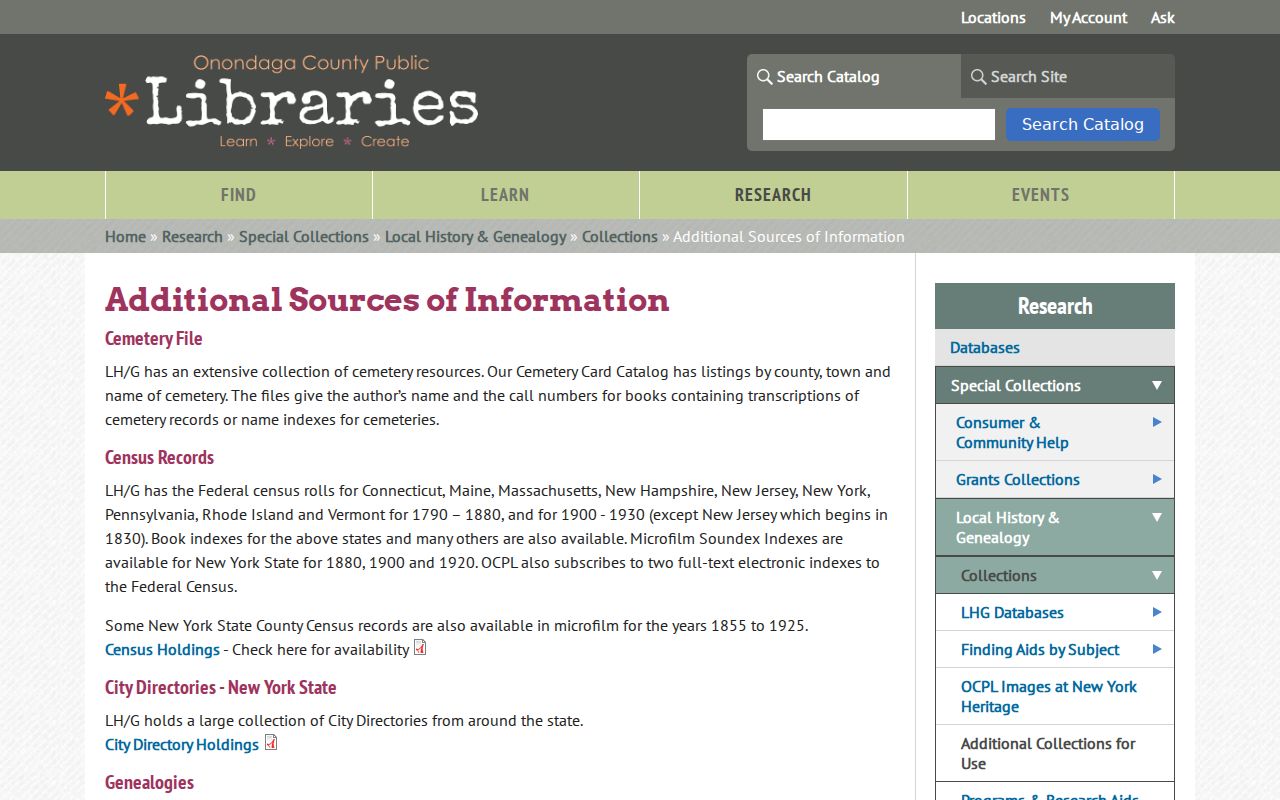
The library source list provides a documented route around the lack of a separate public Salina house-history index.
Salina Past Resident Evidence
Ownership and residence are different questions. A deed can name a nonresident owner, while a city directory can print an occupant who had no title interest. Pair each transfer with available Syracuse directories from 1844 forward, knowing there are gaps and that a Salina address must be checked in the volume's suburb or street coverage. Telephone directories from 1894 forward can bridge some periods, but unlisted people and publication gaps remain. The County Clerk Archives provide a local census path from 1850 through 1925, while the released federal census reaches 1950.
Use a directory year and the nearest census as dated snapshots. The directory may be annual and can use a head-of-household convention; the census is taken on its own schedule and has a publication lag. Test a change with newspapers, the incomplete 1860 to 1996 obituary index, cemetery records, and the property chain. Record the source's date, not just a name copied into notes. This keeps past residents research focused on evidence rather than a reconstructed story.
- Choose a dated deed or assessment point for the address and write down the legal description.
- Find the closest available directory entry, trying initials, surname-first forms, and street variants.
- Ask OCPL for an address section or reverse-directory lead for that year when the surname is unknown.
- Pair the result with the nearest released census and compare the address, household composition, and date.
- Use obituary, cemetery, probate, and later transfer material to test the endpoint.
Note: A directory line and census household are dated publications, so neither alone confirms every person who ever lived at a Salina address.
Salina Estate Record Clues
For family-history questions, an obituary or cemetery result can mark the point where the land trail turns into an estate trail. Search the name and death date in New York WebSurrogate for an estate role, proceeding, letters, related files, and document links. Older public images may require the Onondaga Surrogate public-access computer. The file number and role can then be compared with a later estate deed, release, or transfer in Cott.
This is a practical human use of the record sequence: it can connect an older resident's death date to a representative or heir clue and then to a later recorded transaction. It does not establish a complete family relationship by itself. Vital certificates still have their own eligibility rules, and the obituary index remains incomplete. Keep the probate file number, citation, and deed reference together.
Salina Previous Residents Limits
A title chain cannot prove occupancy. It also cannot establish every renter, guest, utility customer, motor-vehicle address, or protected voter at an address. The assessment roll is owner-centered, and historical directories are publication-centered. A result may be index-only, a citation may lead to a missing article, or an address may appear under an older community label. When no public permit index is available, a focused request should state the address or parcel, date range, record type, and desired format rather than asking for a broad name list.
Lawful use. Salina previous residents research is suited to family history, estate research, and understanding an address over time. New York public records never authorize harassment, tracking, threats, or unwanted contact with a living person.
New York's Address Confidentiality Program and confidential-voter rules can make an otherwise expected address absent or substituted. A missing result is not a negative fact. For non-exempt town or county administrative material that is not online, the focused fallback is a request under the New York Freedom of Information Law, while court, vital, and voter records stay with their specialized custodians.